D&D 5.5e: the 2024 rules, ready to play
The 2024 revision of the fifth edition of Dungeons & Dragons, built from the System Reference Document 5.2.1. Choose 5.5e Compatible when you create a game, and the character builder, the sheets, the conditions and the creature library all follow the 2024 rules.
What D&D is
Dungeons & Dragons is the fantasy roleplaying game published by Wizards of the Coast. One person runs the game: they describe the world, play everyone in it and set the challenges. In RollQuest that person is the GM (Game Master); the rulebooks call them the Dungeon Master. Everyone else plays one adventurer, built from a class (such as fighter, rogue or wizard), a species (such as dwarf, elf or human) and a background (what they did before adventuring).
The table tells a story together. You say what your character does; when the outcome is uncertain, the dice decide. Characters gain levels, from 1 to 20, and each level brings more hit points and new abilities.
The 2024 rules are a revision of the 2014 ones, not a new edition. The core is the same, adventures written for either work with both, and most of the changes tidy up rules that tables found confusing.
How a roll works
Almost every roll is a d20 Test: roll a twenty-sided die, add a modifier, and try to meet or beat a target number. There are three kinds:
- Ability checks, such as climbing a wall or spotting a trap, against a Difficulty Class (DC) the GM sets: 10 is easy, 15 medium, 20 hard.
- Saving throws, to resist a spell, a poison or a fall, against the DC of whatever caused it.
- Attack rolls, against the target's Armor Class (AC).
The modifier comes from one of six ability scores (Strength, Dexterity, Constitution, Intelligence, Wisdom and Charisma), plus your proficiency bonus when you're trained in what you're doing. Advantage means roll two d20s and keep the higher; Disadvantage means keep the lower. A natural 20 on an attack is a Critical Hit, which rolls the damage dice twice, and a natural 1 always misses.
What changed in 2024
| Rule | In the 2024 rules |
|---|---|
| Ability score increases | Come from your background (+2 and +1, or +1 to three scores), not your species |
| Backgrounds | Each also grants an Origin feat, two skills, a tool and starting equipment |
| Subclasses | Every class chooses its subclass at level 3 |
| Weapon Mastery | Barbarians, fighters, paladins, rangers and rogues unlock a weapon's mastery property, such as Topple, Sap or Vex |
| Exhaustion | Each level takes 2 off every d20 Test and 5 feet off your Speed; level 6 is death |
| Heroic Inspiration | Spend it to reroll any die, and humans regain it after every long rest |
Making a character in RollQuest
The character builder walks you through the 2024 rules a step at a time, and the sheet works the numbers out as you go:
- Name Your Character, and a starting level from 1 to 20.
- Choose Your Class, then Choose Your Background and Choose Your Species.
- Set Ability Scores with the standard array, point buy (27 points), 4d6 drop the lowest, or by hand. Your background's increases are added for you.
- Roll Hit Points, then add weapons, equipment and spells.
Start above level 1 and the builder adds a step for every choice those levels bring, such as a subclass or a feat. The finished sheet rolls from a click: a skill, a saving throw, an attack and its damage.
At the table
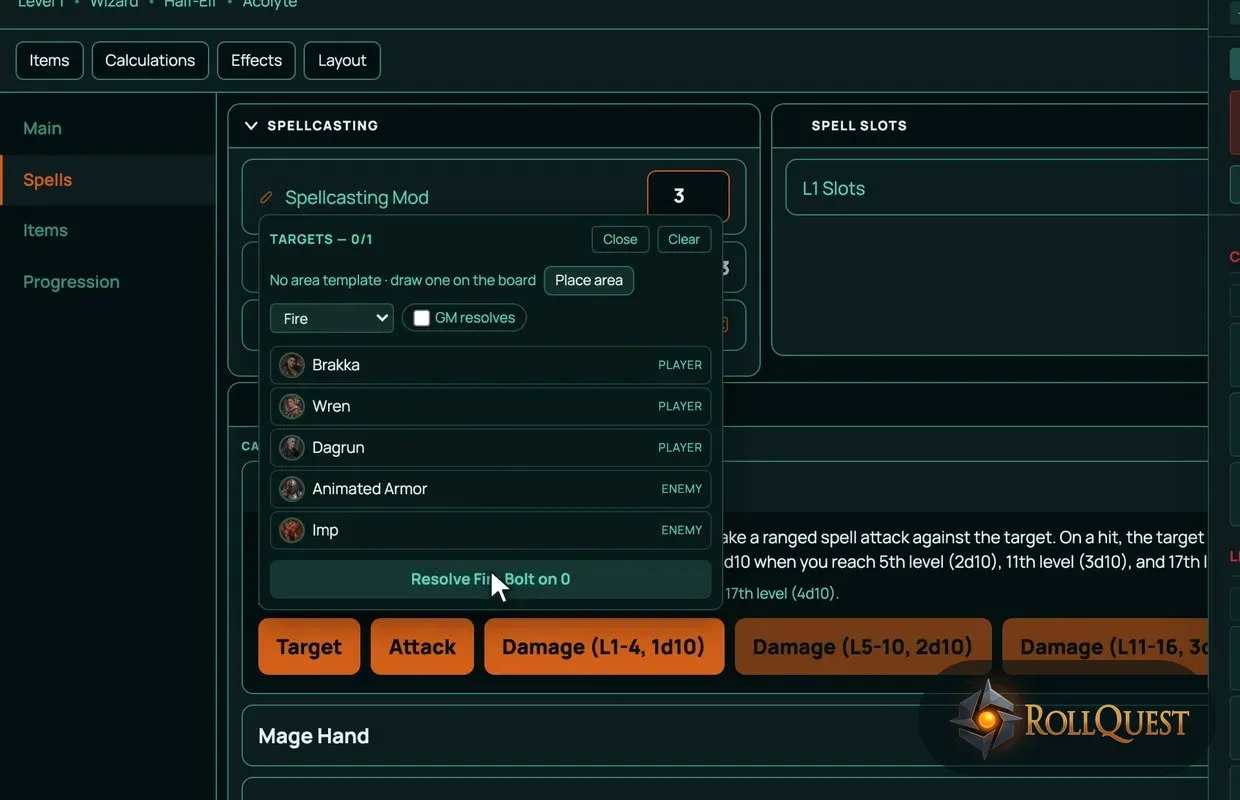
Click Attack on a weapon and RollQuest rolls the attack and its damage. Cast a spell with Target, pick who it hits from the list or the board, and resolve it. Area spells place a template on the map, conditions such as Prone or Frightened run for a set number of rounds, and the combat tracker rolls initiative and keeps the turn order.
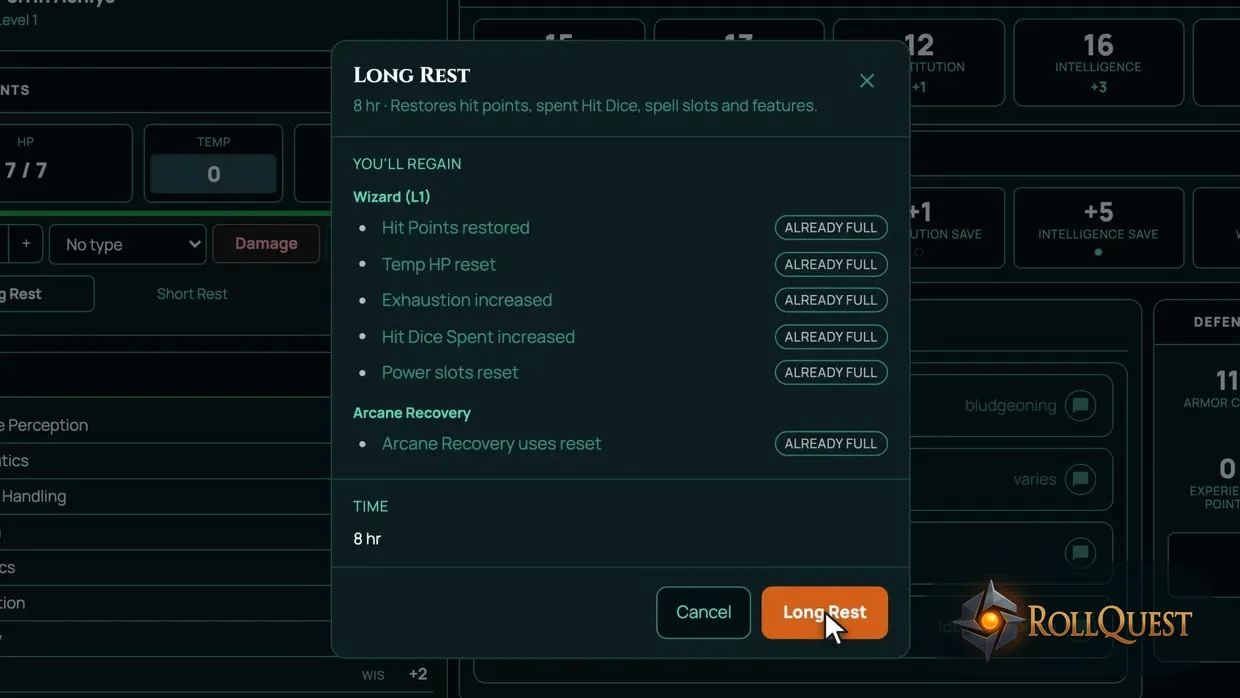
A Long Rest or Short Rest shows a preview of what comes back before you confirm it: hit points, Hit Dice, spell slots and class features. Enemies come from a creature library of SRD 5.2.1 monsters with their numbers already filled in.
Links and downloads
Wizards of the Coast publishes Dungeons & Dragons and owns the game and its name.
The official D&D site has the rulebooks, news and where to buy the full Player's Handbook.
SRD 5.2.1 (PDF) is the free 2024 rules reference RollQuest's 5.5e system is built from. Translations and older versions are on D&D Beyond's SRD page.
The 2024 rules reference on this site lists the SRD 5.2.1 spells, classes, monsters and conditions, free to search with no account.
D&D 5e (2014 rules) is the earlier version, also in RollQuest, if your group plays from the 2014 books.
Licence and trademarks
This work includes material from the System Reference Document 5.2.1 ("SRD 5.2.1") by Wizards of the Coast LLC, available at dndbeyond.com/srd. The SRD 5.2.1 is licensed under the Creative Commons Attribution 4.0 International License.
Dungeons & Dragons and D&D are trademarks of Wizards of the Coast LLC. RollQuest is not affiliated with or endorsed by Wizards of the Coast.
Frequently asked questions
Does RollQuest include everything in the 2024 Player's Handbook?
No. The SRD 5.2.1 is the part of the rules Wizards of the Coast releases for anyone to use: all twelve classes with one subclass each, nine species, four backgrounds, and hundreds of spells and monsters. On Pro, homebrew (in beta) lets you add your own.
Can 2014 and 2024 characters play in the same game?
Each game plays by one system, so pick one for the table. A character from your account library can only join a game on exactly the same system.
Is 5.5e free to play in RollQuest?
Yes. Every game system, 5.5e included, is on every plan, Free included.
Can I switch a game to 5.5e later?
Yes, while the game has no character sheets. Once the first sheet exists, the system is fixed, because every sheet is built on its system's rules.
Try it
Create a game on the free plan, choose 5.5e Compatible under Game System, and build a character in a few minutes.