Ninefold: jailbroken crews in a city sold at auction
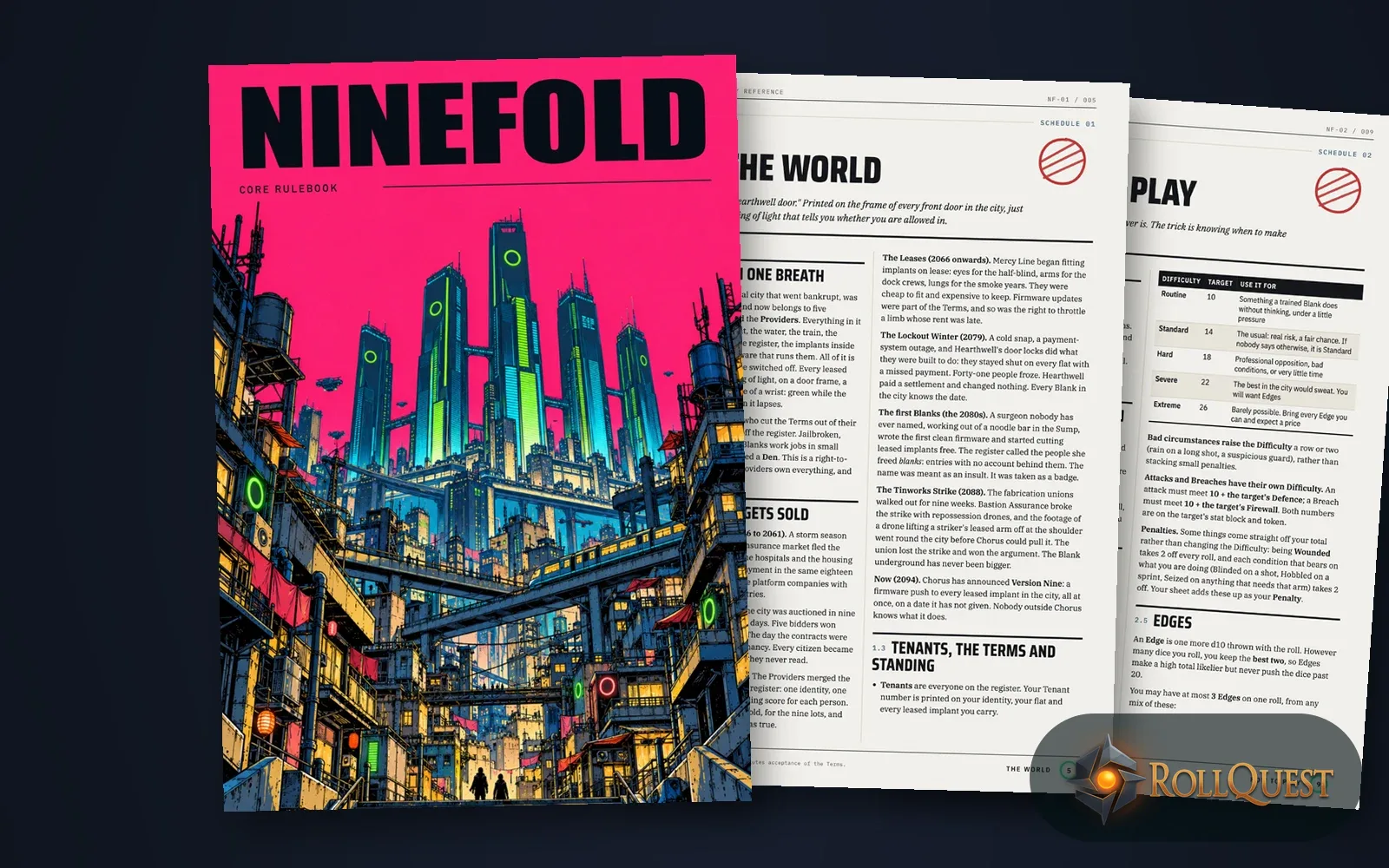
It's 2094, and the city of Ninefold belongs to five companies that lease everything in it, down to the implants in your body and the firmware that runs them. Your crew has cut the leases out, and takes the city back one door at a time. Ninefold is RollQuest's own near-future heist game, with its whole rulebook free to read.
A city sold in nine lots
In 2061 a bankrupt coastal city was auctioned in nine lots, and five companies, the Providers, bought the lot: the housing, the clinics, the roads, the police and the Mesh, the network everything runs on. Every citizen is now a Tenant bound by Terms they never read. Miss a payment and your arm throttles, your eyes play adverts and your front door stays shut.
You play Blanks, people who cut the Terms out of their own bodies and walked off the register, working jobs in a crew from a hideout called a Den: stealing back what was repossessed, breaking Provider locks, fixing what nobody else will. Over it all hangs Version Nine, a firmware update coming to every leased implant in the city at once, and nobody knows what it does.
It's grimy, funny, defiant and hopeful in a crooked way. One player is the Game Master (GM), who plays the city and everyone in it who isn't in the crew.
How a roll works
Say what you're doing. The GM picks the Attribute and the Skill it uses and calls the Difficulty: Routine 10, Standard 14 (the usual), Hard 18, Severe 22 or Extreme 26. Roll two ten-sided dice, add the Attribute and the Skill, and read the first result that fits:
| Result | When |
|---|---|
| Crash | Two or more of the dice you rolled show 1, whatever the total: it goes wrong |
| Jackpot | Two or more show 10, whatever the total: you get it, with 2 Spikes |
| Clear, 2 Spikes | You beat the Difficulty by 10 or more |
| Clear, 1 Spike | You beat it by 5 or more |
| Clear | You meet or beat it |
| Close | You miss it by 3 or less: you still get it, at a price the GM names |
| Miss | You miss by more, and the situation moves on without you |
A Spike buys something extra: 3 more Harm, a second target, doing it quietly or doing it fast. Attacks work the same way, against 10 plus the target's Defence.
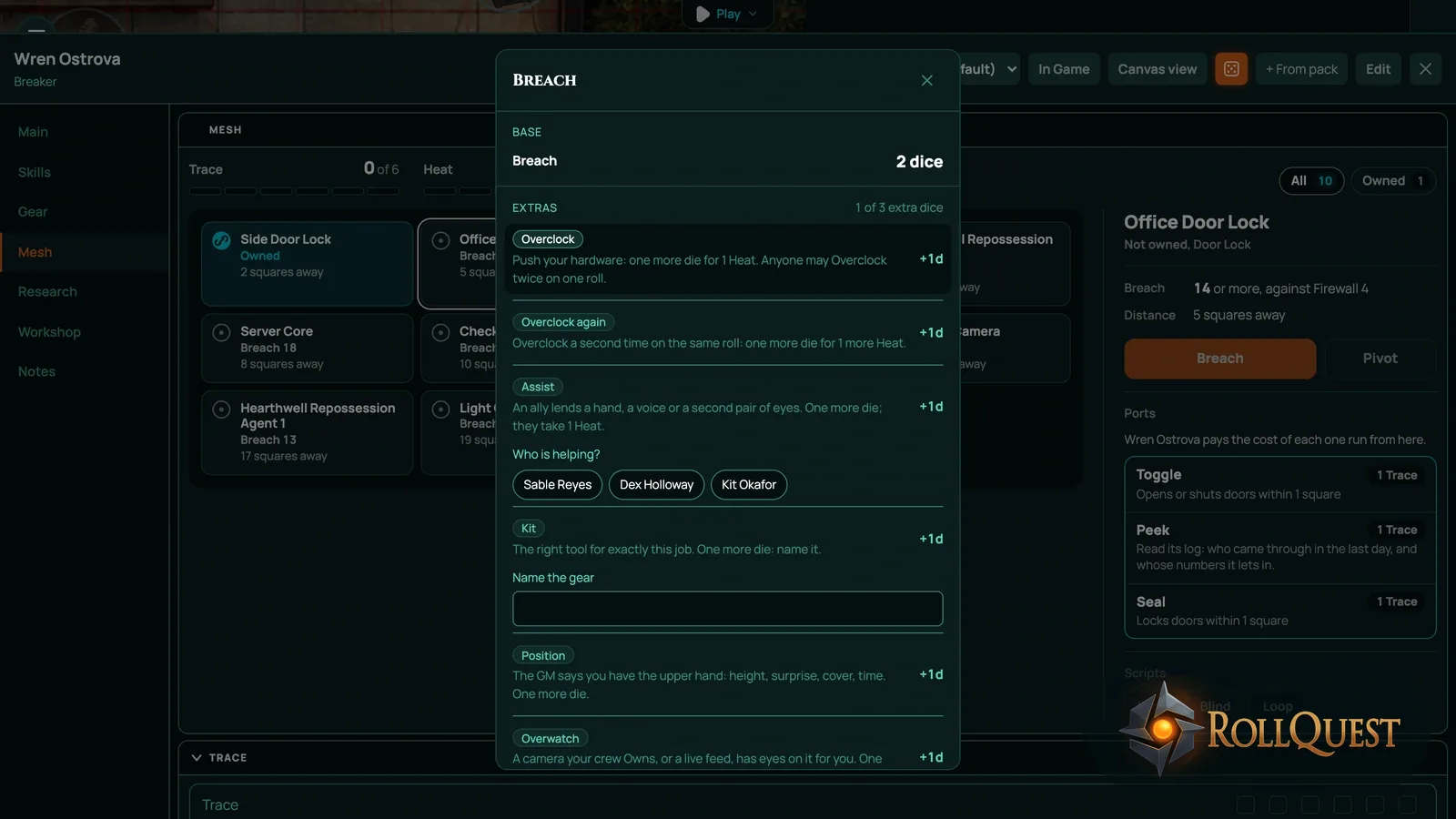
Before you roll you can add up to three Edges: each is one more d10, and you keep the best two. Some are free, such as the right tool for the job. The one you can always reach for is Overclock, one more die for 1 Heat. A Crash or a Jackpot counts every die you rolled, so more dice make both likelier: overclocking is a gamble, on purpose.
Heat, and hacking on the board
Heat is how hard your hardware is running. Overclocking adds it, and so do some guns. Push past your maximum and you burn out: your implants go offline for a turn, and you take a Glitch, lasting damage until you repair it at a bench.
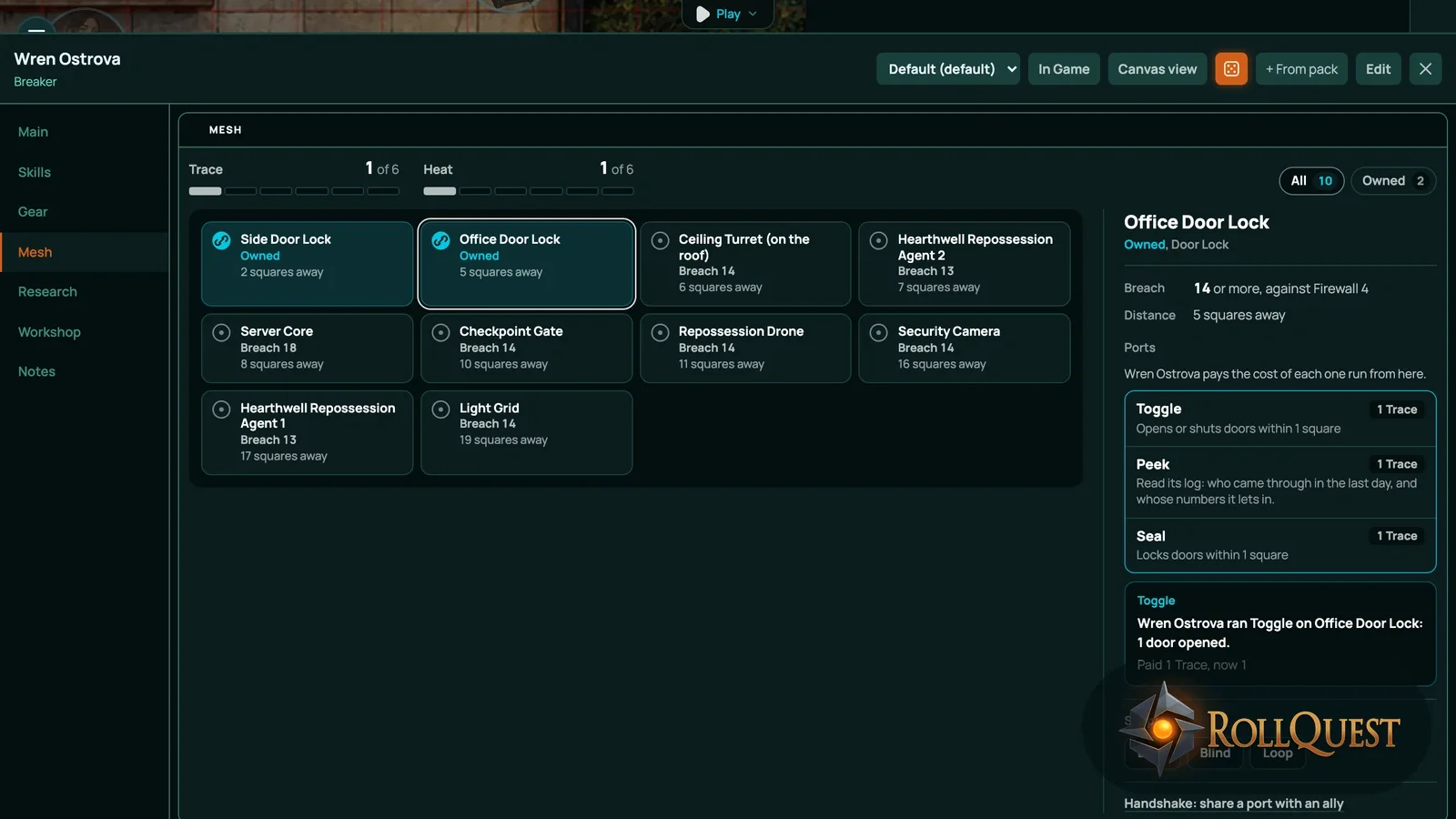
In Ninefold the hacking happens on the board. Every networked thing in a scene, a door lock, a camera, a turret, the lights, even a guard's implanted eyes, is a token with a Firewall. On their turn, in the same round as everyone else, the crew's hacker Breaches a node: Code and Intrusion against 10 plus its Firewall. A hit makes the node Owned, and its Ports open up: open or seal a door, kill the lights, loop a camera, turn a turret. A Handshake passes one port to an ally, so the crew's talker can open the door at exactly the right moment.
Every move on the Mesh leaves Trace, and the whole table watches it climb on the hacker's token. Too much and you're Burned: you lose every node you own, and the Providers hit back. Every wired implant also raises your Exposure, which lowers your own Firewall, so the stronger you build a Blank, the easier they are to hack.
Loot, research and the bench
Blanks don't get rich. They get better equipped. The crew breaks its loot down at a bench into parts and turns what it learns into Insight, which goes into research across five trees: Firmware, Exploits, Fabrication, Biotech and Signal. Each node you unlock gives something lasting, such as cooler implants, a quieter Breach or a schematic: with the right parts and tools, a schematic builds new gear in the Workshop, from printed pistols and drones to hacking scripts and ammunition.
Every weapon takes mods and up to two upgrades, such as a sight on a pistol or a shock coil on a baton, and they come off again at a bench. Guns fire from a magazine and reload from boxes of rounds, so ammunition is something you buy, build or loot.
Making a Blank
- A Trade, what you do on a job: Breaker (the hacker), Hardcase (hired protection), Wrench (builder and drone-maker), Stitch (back-alley surgeon), Lens (auditor and streamer), Suit (a Provider manager gone rogue), Badge (a claims enforcer who walked out), Plug (the connect), Rover (smuggler and driver) or Spark (pirate broadcaster). It brings a Signature, a trick only that Trade has, a starting kit and one free research node.
- Five Attributes, Frame, Flow, Code, Poise and Pull. Each starts at 1, and you spend 7 points, no more than 4 in any one.
- 17 Skills, from Shoot and Sneak to Intrusion, Tinker, Patch and Streets. You spend 14 points, no more than 3 in any one, starting from your Trade's suggested set.
- A Spec, the trick you're known for, from your Trade's five. You buy more later with Marks, your experience.
Ninefold in RollQuest
Set Difficulty on the sheet's Main page to the number the GM calls, with its own minus and plus, then click a skill or Research. The pool builder starts from two dice and offers the Edges as chips, from Overclock to Overwatch, never more than three at once, and takes Overclock's Heat for you. The result names itself, such as Clear, 1 Spike. Aim an attack with Target, or a Breach from a node on the Mesh page, and the same roll is read against the target's own Defence or Firewall: a hit lands by itself, its damage roll offers Spike for 3 more Harm, and a Jackpot leaves the target Wounded. Overflowing Heat puts Burnt Out on your token, and a Crashed Breach leaves you Pinged.
The character builder walks through Name your Blank, Choose a Trade, Set your Attributes, Set your Skills and Choose a Spec. Once a node is yours, its ports are buttons on the sheet's Mesh page: a Door Lock's Toggle opens the real door on the map, and a Light Grid's Kill puts out the scene's lights. You Invest Insight on the Research page, and RollQuest rolls the check when you Build on the Workshop page. A weapon's card shows its mod slots, with Attach a mod, and, on a gun, the magazine and Reload: every shot spends its round. The rests are Cool Down, at the end of a scene, and Downtime, between jobs.
The crew can share a Den sheet with its own research and workshop, where each player builds with their own character's hands, and a Clocks panel keeps the Providers' attention in view, all on every plan. Research, the Workshop, mods and the Mesh page are part of RollQuest itself, so a homebrew system can use them too.
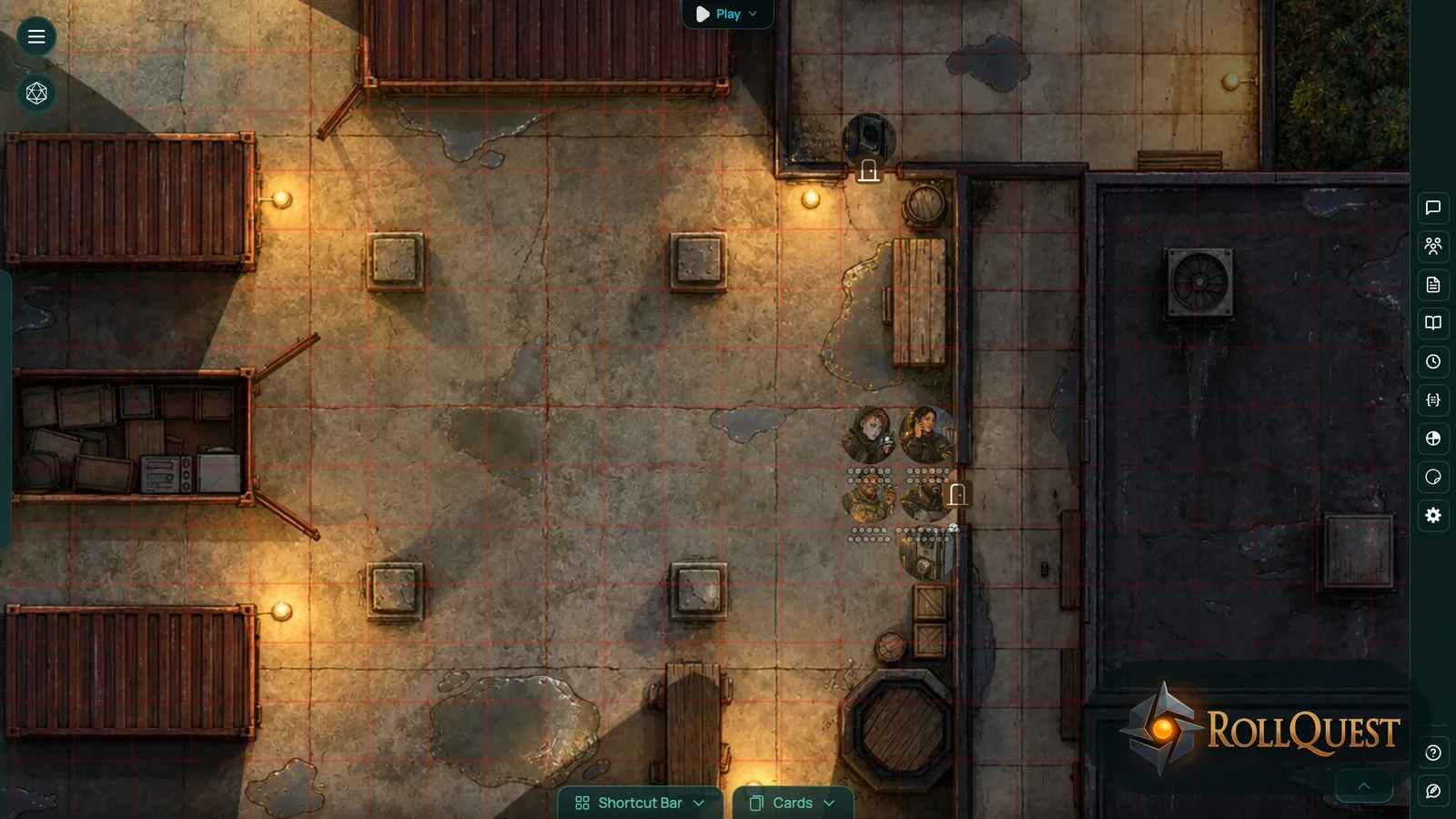
To start playing straight away, choose Use Content Pack in Create Game and pick The Repo Yard: a Hearthwell repossession yard one night after rain, where a dock fitter's arm waits in a container to be wiped at dawn, and the crew slips in through a jailbroken side door to take it back. While Ninefold is the chosen system, Read the Ninefold rulebook sits under the Game System list and opens this page in a new tab.
Links and downloads
The Ninefold rulebook (PDF) is the complete game: the world, how to play, making a character, the rules, equipment, adversaries and the Mesh nodes, running the game with a starter job, art direction for maps and tokens, and a quick reference. Version 1.0, 90 pages, free.
Playing Ninefold in the documentation takes a table from the first click to a full job: starting the adventure, building a Blank, rolling with Edges, hacking the Mesh, research and the Workshop.
RollQuest wrote and publishes Ninefold. It's one of four games of our own, with Ashfall, Brightline and Tidewrack.
Creative Commons Attribution 4.0 is the licence on Ninefold's rules, so you can use them in a game of your own.
Open rules
The game rules and mechanics in the Ninefold rulebook (the rolls, results, Edges, Heat, the Mesh, research, crafting, advancement and the procedures that use them) are released under the Creative Commons Attribution 4.0 International licence. You may copy, adapt and sell work that uses them, provided you credit: "Based on Ninefold by RollQuest, licensed under CC BY 4.0."
Everything else stays © RollQuest, all rights reserved: the setting and its history, all names of people, places, companies, factions and creatures, the stories and examples, the illustrations, the book design and the RollQuest name and logo.
Frequently asked questions
Is the Ninefold rulebook free?
Yes. The PDF is free to download and read, and you don't need an account.
What dice do I need?
Ten-sided dice. Five for each player is plenty, since a roll never uses more than two dice plus three Edges.
Can I use Ninefold's rules in my own game?
Yes. The rules are under CC BY 4.0, so you can adapt and sell work that uses them with the credit line above. The setting, names and art are not part of that licence.
Is Ninefold on the free plan?
Yes. Every game system, Ninefold included, is on every plan, Free included, and so are its research, Workshop, mods and Mesh page.
Try it
Create a game on the free plan, start from The Repo Yard or choose Ninefold under Game System, and build your first Blank.