

Playing Brightline
Play Brightline, RollQuest's own d20 superhero game: start a game from Checkpoint North-7, build a hero, roll checks, take hits and rest.
Brightline is a game about people with powers choosing to help. You build a hero from ranks and powers, roll a twenty-sided die (a d20) when the outcome is in doubt, and nobody has hit points: a hit makes you resist it, and the harm builds up as conditions instead. This page is for the whole table. Players learn how to build a hero, read the sheet and roll; the Game Master (GM), the person who runs the game, learns how to set a game up, call the numbers, run the villains and hand out Shine. Brightline is on every plan, and so is its adventure.
Brightline in plain words
The premise
At 21:14 on 14 October 2006 the whole sky burned white for nine minutes, everywhere at once. Nothing recorded it, but by morning about one person in ten thousand had woken Lit: stronger, faster, or able to boil a kettle by looking at it. Twenty years on, in 2026, the Lit are a fact of life. Licensed heroes carry a Charter, a public rating and the right to use their powers in public; unlicensed Lit are Off-Line. The game is set in Calder Bay, a cold northern coastal city with more Lit than almost anywhere, where rescues are livestreamed and a hero's rating can matter as much as their arrest record. On the north shore lies the Scorch, forty quarantined blocks where reality still flickers, and creatures called Afterimages walk out of it. The tone is bright and hopeful: heroes win more often than not, and the win costs them something in public.
Every roll is one d20 plus a rank, a number from your sheet. A check, such as forcing a shutter or calming a crowd, is rolled against a Difficulty the GM calls, and the result is counted in Steps: one Step for every 5 points you beat it or miss it by. An attack is rolled against 10 plus the target's Evade (at range) or Guard (up close). A hit doesn't take anything away: the target rolls to resist it, and each failure leaves them Dinged, then Rattled, Reeling and finally Down. Heroes are built from a budget of points set by the game's Scale, and their luck is Shine, which buys a reroll of a failed check. There are no levels, no classes and no hit points to count.
The adventure it comes with
Brightline comes with a free one-scene adventure, Checkpoint North-7. One gate in the fence round the Scorch has jammed open, a dog made of streetlight is pacing the street beyond the wire, the Bureau's response team is twenty minutes away, and someone at the bus stop is already streaming. It's a short fight on a clean, readable board, made for learning the rules.
Start a game
- On your dashboard, click New Game. The Create New Game window opens.
- Choose Use Content Pack, then Campaign if the window asks.
- Click the Checkpoint North-7 card to pick it. To look inside first, click Preview (the four arrows in the card's top-right corner), then Use this pack. The Game Name fills in as Checkpoint North-7 - Copy; change it if you like.
- Check that Game System says Brightline Core. The pack is written for Brightline but carries no system of its own, so the window asks, starting on the system it works best with, and says so under the list: Works best with Brightline (d20 heroes). You can pick any system, or None. Keep Brightline: pick None (generic HP) and the game has none of Brightline's rules.
- Click Create Game. You go straight into the new game.
The game holds one scene and one map, the checkpoint itself, 30 by 20 squares, in daylight, with no phases. A double chain-link fence with razor wire runs down the middle, broken only by the gate, which starts closed: four of its doors are locked, so the GM opens them when the story says (see Doors). On the city side are the North-Shore Street, the Bureau's patrol yard, a glass Bureau booth and a bus stop; Patrol Officer Ruth Okonjo, a non-player character (NPC) who isn't Lit and won't fight, sits at her desk in the booth. On the Scorch side the streetlights burn at noon: Ghostlight, a villain, waits beside a stranded tram, and two Scorch Flickers, Mooks, hover by the fence. The board starts in daylight with fog of war on. Ghostlight, the Flickers and Okonjo start hidden, so the GM reveals them when the heroes reach the fence. Ghostlight and the two Flickers arrive linked to their stat blocks among Brightline's villains, so their defences and actions are there from the first hit (see Villains and Mooks); Okonjo, who won't fight, has none. The pack brings no hero tokens, by design: add each hero's token (see Add player characters) and it stands on the party start, on the city side by the gate, each hero after the first on the next free square round it.
The board has three hazards for the GM to rule on: anyone who ends a turn in the lilac static zone makes a Nerve check against a Difficulty you set (15 is a real effort) or is Dazzled; crossing the razor wire between the fences leaves you Hindered; and the lone front door with no house behind it puts whoever steps through somewhere else. Like every campaign pack, it brings no characters: each player makes a hero, below.
To start a Brightline game without the adventure, choose Start from Scratch in step 2 and Brightline Core under Game System. See Create a game and Game systems.
Make a hero
Start a character the usual way: as a player from Character Sheets on your dashboard, choosing Brightline as the Game system, or as the GM with New Sheet in the game. See Create a character. The builder then takes you through three steps:
| Step | What it asks | Required? |
|---|---|---|
| Name Your Hero | The hero's name. | Yes |
| Choose an Archetype | One of ten ready-made heroes to start from. | No: Skip builds from nothing |
| Spend Build Points | How you spend the hero's budget on abilities, defences and skills. | Yes |
The builder opens on Name Your Hero, with any name the sheet already has filled in: click Next to keep it. Next, Back, Start Again and Cancel work as they do for every system: see Move through the steps.
Name Your Hero
Under Identity, type the Character Name, up to 80 characters. Brightline has no levels, so there's no Starting Level to pick.
Choose an Archetype
An archetype is a complete hero, built for a Scale 10 game, that you can take as it is or tune. Click an archetype's card to select it, then click Add 1 & Continue (a line above it says one is selected): its powers and Edges arrive on the sheet already built at their ranks, and the next step offers its abilities, defences and skills as a suggested build. Type in Search by name to find one. A long description folds after four lines: Read more opens it.
A hero takes one archetype: clicking another card selects it in place of the first. If the hero already has one, from an earlier run of the builder, the new pick replaces it. The archetype then shows under the hero's name at the top of the sheet, such as Brick.
| Archetype | Concept | Powers | Edges |
|---|---|---|---|
| Brick | Stronger than anything that should be, and built to stand in front of everyone else. | Protection 6, Leap 6, Immunity 5, Regenerate 5, Burrow 4, Senses 2 | Interpose 1, Heavy Hitter 3, Takedown 2, Hard to Kill 1, Second Wind 1, Iron Will 1, Streetwise 1, Benefactor 2, Danger Sense 1 |
| Speedster | Faster than the livestream can keep up with. | Speed 10, Quickness 5, Leap 4, Senses 2, Feature 2 | Tough as Nails 2, Quick Off the Mark 2, Fast Draw 1, Strike First 1, Takedown 2, Trip 1, Second Wind 1 |
| Blaster | Lightning in a person-shaped jar. | Blast 10 and Snare 10 (the Arc suite), Flight 4, Protection 4, Immunity 5, Senses 3, Comprehend 2, Feature 2 | Sure Aim 1, Cover Fire 1, Danger Sense 1, Camera Ready 1 |
| Mentalist | The quiet one, who hears what everyone else is thinking. | Illusion 8, Drain 10 with Ranged, and Mind Read 8 (the Mind suite), Mind Link 3, Protection 6, Comprehend 2, Remote Sight 3, Senses 2, Immunity 4 | Iron Will 1, Inspiring 2, Danger Sense 1, Well Connected 1 |
| Gadgeteer | No power at all, and a garage full of answers. | Blast 7, Snare 7 and Move Object 6 (the Gauntlets suite), Flight 4, Protection 6, Remote Sight 3, Senses 4, Comprehend 2, Variable 1, all with Gadget; Feature 4 | Inventor 1, Equipment 3, Hideout 2, Know-It-All 1, Fast Draw 1, Benefactor 2 |
| Martial Artist | Trained, not Lit, and better than most who are. | Weaken 4, Leap 3, Senses 2, Wall-Crawl 1, Regenerate 3 | Tough as Nails 2, Takedown 2, Trip 1, Disarm 1, Feint 1, Grab Hold 1, Strike First 1, Second Wind 1, Danger Sense 1, Quick Off the Mark 2, Interpose 1, Hard to Kill 1, Iron Will 1, Teamwork 1 |
| Shapeshifter | Whoever the room needs you to be. | Morph 3, Elongate 6, Insubstantial 1, Shrink 4, Regenerate 3, Senses 2 | Silver Tongue 1, Streetwise 1, Danger Sense 1, Off-Line Network 1 |
| Mystic | Reads the Scorch's static like scripture. | Blast 10, Illusion 8, Teleport 6 and Healing 5 (the Arcana suite), Protection 5, Senses 3, Comprehend 2, Remote Sight 2, Immunity 3 | Lucky 1, Iron Will 1, Know-It-All 1 |
| Flyer | The sky over Calder Bay is yours. | Flight 10, Protection 4, Senses 2, Move Object 6 | Slippery 2, Strike First 1, Danger Sense 1 |
| Leader | The one the team looks at when it all goes wrong. | Affliction 6 with Ranged, Protection 4, Mind Link 3 | Born Leader 1, Inspiring 3, Teamwork 3, Charter 1, Camera Ready 2, Well Connected 1, Benefactor 2, Interpose 1, Iron Will 1 |
Taken as it is, each archetype spends exactly 150 build points, the budget of a Scale 10 hero, inside every cap. A suite is an Alternate suite: powers that share one cost, with one of them active at a time (see Build a power).
Skip builds a hero from nothing: every rank starts at 0 and the whole budget is yours. The builder itself gives a hero no powers, though: see Add a power or an Edge before you skip.
Spend Build Points
A hero gets 15 build points for every point of Scale: 150 in a Scale 10 game. Everything costs points:
| What you buy | Cost | Limits |
|---|---|---|
| A rank in an ability (Might, Grit, Agility, Aim, Combat, Mind, Sense, Heart) | 2 points | From -5 to 20. A rank below 0 gives its 2 points back. 0 is an ordinary person, 2 a trained one, 5 or more beyond anyone who wasn't Lit. |
| A bought rank in a defence (Evade, Guard, Vigor, Nerve) | 1 point | 0 to 20 bought ranks, on top of the ability the defence is built on |
| A bought rank in a skill | 1 point for every 2 ranks | 0 to 40 ranks, on top of the skill's ability |
| Powers and Edges | What each one costs as built | Set on the sheet, not in this step |
Durability is never bought: it's your Grit plus what your powers and Edges add, such as Protection. Four caps keep a hero inside the game's Scale:
- Evade + Durability can be at most twice Scale (20 at Scale 10), and so can Guard + Durability, and Vigor + Nerve.
- No skill can be higher than Scale + 10 (20 at Scale 10).
- A power's attack bonus plus its rank can be at most twice Scale. RollQuest doesn't check this one: the GM does.
The step, from top to bottom:
| Part | What it shows or does |
|---|---|
| The step's prompt | The costs and caps above, in one paragraph. |
| Build points | What's left, such as 109 left of 150, and, in brackets, what your powers and Edges already cost (41 spent elsewhere). Over budget, it says how far over instead. |
| Use the suggested build | Only after picking an archetype. Fills every row with the archetype's own spend, and every other row with 0. You can change any row afterwards. |
| The reasons line | Why Next is off, such as That is 3 points more than there is to spend., Evade + Durability would be 22; together they can be at most 20. or Athletics would be 21; the most it can be now is 20. Up to four show at once. |
| A row per ability, defence and skill | Its name, the budget it draws on (Build points), its cost (2 per rank, 1 per rank or 0.5 per rank), its value with these points, with its cap after a slash where it has one, such as 20 / 20, then −, the number of ranks, and +. |
For a defence or a skill, the number in the box is the ranks you buy; the value beside it is the total, with the ability added. Dana Holt, a Brick, buys 4 ranks of Evade on top of Agility 2, so her row shows Evade 6.
Next stays off while anything breaks a rule. It works with points still unspent: they show on the sheet as Points left. Click Finish on this last step.
Scale
Scale is how big the game is: 6 for street-level heroes, 10 for a Calder Bay team (the default, and what the archetypes are built for), 14 for a world-saving one, anywhere from 1 to 20. It's the Scale field in the Hero block of every hero's sheet, and it starts at 10. As the GM, tell your players the game's Scale before they build: their budget and caps follow it.
To build a hero at another Scale, set it before Spend Build Points: click Cancel to leave the builder, click Edit at the top of the sheet, change Scale, click Done, then Edit again and Re-run character setup. To change it on a finished hero, change Scale the same way: Build points grows or shrinks by 15 for each point, and Points left shows the difference to spend or win back.
Build a power
Every power and Edge on a hero is built by rank. To change one, open its row on the sheet (a power on the Hero tab, an Edge on the Build tab) and click Build. A window titled with its name opens:
| Control | What it does |
|---|---|
| Rank, with − and + | The power's rank, between the limits shown beside it, such as 1 to 20. |
| Boosts | Extras that add to the cost, each with its cost (+1 per rank or +1 once) and what it does. Tick one to add it. Only the Boosts this power can take are listed. |
| Limits | Drawbacks that lower the cost, the same way (−1 per rank or −1 once). |
| Alternate suite | A name, up to 40 characters, such as Arc. Powers with the same suite name share one cost, and only one of them is active at a time. Earlier suite names are offered as you type. Empty (None) keeps the power on its own. |
| The preview | Cost, such as 20 points, or 4 points (1 per 2 ranks); Attack, the roll and the defence it's against, or No roll to hit; Resisted with, such as Durability, DC 25; and the suite's cost, such as Arc: 21 points for 2. It updates as you change things. |
| Cancel, Save | Save builds the power on the sheet. Cancel changes nothing. |
A Boost or Limit that can't go with one you've ticked is greyed out: a Ranged power can't also be Touch or Perception, for instance. An Edge offers no Boosts or Limits.
How a power's cost works out:
- Rank × cost a rank. A Blast costs 2 a rank, so Blast 8 is 16 points.
- A Boost or Limit per rank adds or takes 1 from the cost a rank: Blast 8 with Area is 3 a rank, 24 points; with Tiring, 1 a rank, 8 points.
- A flat Boost or Limit adds or takes 1 point once: Blast 8 with Subtle is 17.
- Under 1 a rank, it goes fractional. At 0 a rank a power costs 1 point for every 2 ranks (Blast 8 with Tiring and Unreliable is 4 points); at -1 a rank, 1 point for every 3, and so on, rounded up. Nothing costs less than 1 point in all.
- An Alternate suite costs its dearest power plus 1 point for each other power in it. The Blaster's Arc holds Blast 10 (20 points) and Snare 10 (10 points), so the pair costs 21.
- Edges cost 1 point a rank.
Saving a build changes Spent on powers and Edges and Points left on the sheet's Build tab straight away, and a power that adds to a number, such as Protection to Durability, changes that number too. Points left below 0 means the hero is over budget for the Scale.
In an Alternate suite, each power's row has an Active switch: switching one on switches the others in the suite off.
Add a power or an Edge
Archetypes bring their powers and Edges with them. To add one an archetype didn't bring, or to give a hero built from nothing their powers, use + From pack at the top of the sheet. It's on every plan, and you don't need Edit:
- Open the hero's sheet and click + From pack at the top. The Add from this table's packs window opens.
- Brightline's powers and Edges are listed under Brightline Core, with a count. Type in Search by name to find one.
- Click + Add next to the one you want. It arrives at rank 1.
- Open its row on the sheet (a power on the Hero tab, an Edge on the Build tab) and click Build to set its rank.
Archetypes aren't listed there: a hero has one, from Choose an Archetype in the builder, or from Edit and Re-run character setup. See Inventory and money.
On Pro, the sheet's Items panel (in beta, so it may not be on your account yet) has a + From pack of its own: click Edit, then Items in the Edit toolbar, then the Powers or Edges tab. See Add items in the Items panel.
The powers
Each power's rank sets how strong it is. Powers marked with an attack are aimed with Target (see Attacks); the rest describe what your hero can do, for the GM to rule on, and a few change a number on the sheet.
| Power | Points a rank | What it does |
|---|---|---|
| Affliction | 1 | Close. Brawling against 10 + Guard; the target resists with Vigor against 10 + rank: Hindered, then Immobile, then Paralysed. |
| Barrier | 2 | A wall with Durability equal to its rank: rank 1 fills a doorway, 5 a street, 10 a city block. |
| Blast | 2 | Ranged energy attack. Marksmanship against 10 + Evade; the target resists with Durability against 15 + rank. |
| Burrow | 1 | Dig through earth at a walking pace; through concrete at rank 5, bedrock at 10. |
| Clone | 3 | One copy of you per rank, each a Mook with your traits at your rank minus 5. Ranks 1 to 10. |
| Comprehend | 2 | Understand one kind of thing per rank, such as every language or machines, and answer back. Ranks 1 to 4. |
| Concealment | 2 | Go unseen: one sense at rank 1, sight at 2, every sense but one at 4, everything at 5. Finding you is Notice against 10 + rank. Ranks 1 to 5. |
| Create | 2 | Solid things as large as a person per rank, with Durability equal to the rank. |
| Dampen | 2 | A field: anyone in it who uses a power rolls Nerve against 10 + rank, or the power fails this turn. |
| Drain | 1 | Close mental attack. Brawling against 10 + Guard; resisted with Nerve against 10 + rank: Impaired, then Disabled, then Entranced. |
| Elongate | 1 | Every rank doubles your reach. |
| Enhance | 1 | Add the rank to one ability, defence or skill you name while it's on. Write the boosted number on the sheet yourself. |
| Feature | 1 | A small, useful oddity per rank: perfect memory, a built-in light, gills. |
| Flight | 2 | Rank 1 keeps pace with a runner; each rank after that roughly doubles your top speed. |
| Grow | 2 | Adds its rank to Durability on the sheet, and to anything you lift or throw, but takes 2 off Evade. Ranks 1 to 10. |
| Healing | 2 | Close. Once a scene per patient: clear one Dinged per rank, or end Rattled or Reeling. At rank 5, bring someone back from Down. |
| Illusion | 2 | Perception mental attack, no attack roll: everyone who sees it resists with Nerve against 10 + rank: Dazzled, then Entranced, then Compelled. |
| Immunity | 1 | One thing can't hurt you: 1 rank a narrow danger, 5 a broad one, 10 a whole kind of hit. |
| Insubstantial | 5 | Liquid at rank 1, mist at 2, light at 3, a ghost at 4. Kinetic hits can't touch you at 3 and 4. Ranks 1 to 4. |
| Leap | 1 | Rank 1 clears a car, 5 a street, 10 a tower. |
| Mind Link | 1 | A private line: one person at rank 1, a team at 3, anyone you've touched at 5. Ranks 1 to 5. |
| Mind Read | 2 | Your rank + Sense against 10 + their Nerve: surface thoughts at 1 Step, memories at 2, what they hide from themselves at 3. |
| Morph | 5 | One other face at rank 1, anyone your build at 2, anyone at 3, anything your size at 4. Seeing through it is Read against 10 + 5 × rank. Ranks 1 to 4. |
| Move Object | 2 | Ranged kinetic attack with whatever you lift. Marksmanship against 10 + Evade; resisted with Durability against 15 + rank. |
| Nullify | 1 | Your rank + Sense against 10 + the power's rank switches someone's power off until they spend a turn bringing it back. |
| Protection | 1 | Adds its rank to Durability on the sheet. |
| Quickness | 1 | Everyday things very fast, and twice the rank on Initiative. Ranks 1 to 10. |
| Regenerate | 1 | Dinged fade faster: one a round at rank 5, every one at the end of each of your turns at 10. At 20 you get up from Down. |
| Remote Sight | 2 | See somewhere else: the next room at rank 1, the city at 5, anywhere you've been at 10. You're Defenceless while you look. Ranks 1 to 10. |
| Senses | 1 | One sharper or stranger sense per rank. |
| Shrink | 2 | Cat-sized at rank 4, insect-sized at 8. Adds its rank to Evade and Guard on the sheet, and to Stealth, which you add yourself. Ranks 1 to 8. |
| Snare | 1 | Ranged attack. Marksmanship against 10 + Evade; slipped with Evade against 10 + rank: Hindered and Vulnerable, then Immobile and Defenceless. |
| Speed | 1 | Rank 1 outruns a sprinter, 5 a car on the freeway, 10 a jet. Above rank 6 you can run on water. |
| Summon | 2 | Close. A helper that's a Mook with traits at the rank, and leaves when the scene ends. Ranks 1 to 10. |
| Swim | 1 | Move through water as easily as air, and hold your breath a minute per rank. |
| Teleport | 2 | A move. Across the room at rank 1, the city at 5, anywhere you've been at 10. |
| Transform | 2 | Close. Brawling against 10 + Guard; a person resists with Vigor against 10 + rank: Impaired, then Disabled, then turned to glass, wood or salt and Paralysed. |
| Variable | 7 | A power that becomes others: 5 points of powers, Boosts and Limits per rank, rearranged with a minute's concentration. Ranks 1 to 5. |
| Wall-Crawl | 1 | Walk on walls and ceilings; at full speed at rank 2. Ranks 1 to 2. |
| Weaken | 1 | Close. Brawling against 10 + Guard; resisted with Vigor against 10 + rank: Impaired, then Disabled, then Down. |
Ranks run from 1 to 20 unless the table says otherwise. Each power also says what it takes to use (a Standard, Move or Free action, or None), its range (Close, Ranged, Perception or Personal) and how long it lasts (Instant, Sustained or Permanent).
Boosts and Limits
Only four change what RollQuest rolls: Ranged and Touch change the attack's skill and defence, and Perception and Area take the attack roll away. The rest are rules for the table: RollQuest doesn't add Sure-Shot's +2 or take off Wild's 2, for instance.
| Boost | Cost | What it does |
|---|---|---|
| Ranged | +1 a rank | Reaches across the street: the attack uses Marksmanship against 10 + Evade. |
| Perception | +1 a rank | If you can see it, it's hit: no attack roll, the target goes straight to resisting. |
| Area | +1 a rank | A burst that catches up to six targets, with no attack roll; each target resists. |
| Subtle | +1 once | Nobody can tell you're doing it without a hard Notice check. |
| Precise | +1 once | Use it at any lower rank, or thread it through a crowd. |
| Sure-Shot | +1 once | +2 to the attack roll. |
| Flurry | +1 a rank | Beat the target's defence by 5 or more and the hit's rank goes up by 2. |
| Piercing | +1 a rank | A hit is resisted as if the target had no Protection. |
| Shared | +1 a rank | Give the power to someone else for the scene, with a touch. |
| Phase-Touch | +1 once | Works on the insubstantial: ghosts, mist, half-gone Afterimages. |
| Spreading | +1 a rank | Anyone who touches the target has to resist it too. |
| Stacking | +1 a rank | The target resists the total of every rank that has landed this scene. |
| Long Reach | +1 once | A close power that reaches a few paces past your arm. |
| Seeking | +1 once | Missed? It tries again on your next turn. |
| Around Corners | +1 once | It can start from anywhere near you. |
| Inborn | +1 once | It can't be Nullified or Dampened. |
| Lingering | +1 a rank | A sustained power stays on without you; an instant one lasts a round more. |
| Bank Shot | +1 once | Bounce it off a wall to hit someone in cover. |
| Aftershock | +1 a rank | The target resists it again at the start of your next turn. |
| Discerning | +1 a rank | An area power that misses the people you choose. |
| Fork | +1 once | Split the rank between two targets. |
| Snap | +1 once | Switch it on as a free action rather than a move. |
| Undoable | +1 once | Take it back at will: release a Transform, wake an Entranced. |
| Steadfast | +1 once | Rattled and Reeling don't end it; only Down does. |
| Lasting Wounds | +1 once | The conditions it leaves heal only with time, not powers. |
| Limit | Cost | What it does |
|---|---|---|
| Touch | -1 a rank | Only up close: the attack uses Brawling against 10 + Guard. |
| Tiring | -1 a rank | Each use leaves you Rattled until the end of your next turn. |
| Unreliable | -1 a rank | Roll a d20 before each use: on 10 or less, nothing happens. |
| Limited | -1 a rank | Only in one situation you name: in water, at night, against machines. |
| Noticeable | -1 once | A glow, a hum, a smell of ozone. |
| Activation | -1 once | You spend a move switching it on first. |
| Focus | -1 a rank | You hold still and concentrate: no move while it's on. |
| Exposing | -1 a rank | Using it leaves you Vulnerable until your next turn. |
| Fading | -1 a rank | Each use takes a rank off it until you rest. |
| Backlash | -1 once | If it's Nullified or fails, you take a hit at its rank. |
| Hold-Based | -1 a rank | Only on someone you already have Grabbed. |
| Wild | -1 once | -2 to the attack roll. |
| Catch | -1 once | A small cost the GM brings in now and then. |
| Short Range | -1 once | A ranged power that reaches only across a room. |
| Gadget | -1 a rank | It's a device: it can be taken, broken or stolen. |
| Easy to Shake | -1 once | The target gets another check to throw it off at the end of each of its turns. |
| Line of Sight | -1 a rank | Only on someone who can see you (or hear, or smell you: choose one). |
| Price | -1 a rank | Fail with it and you resist it too, at its rank. |
| Runaway | -1 a rank | Once it's on, the GM decides what it does next. |
| Always On | -1 once | You can never switch it off. |
Edges
Edges are knacks, contacts and tricks. Each costs 1 point a rank. Four change a number on the sheet for you: Tough as Nails, Slippery, Brawler's Guard and Quick Off the Mark. The rest are for you and the GM to apply as they come up.
| Edge | Ranks | What it does |
|---|---|---|
| Tough as Nails | 1 to 5 | Adds the rank to Durability. |
| Slippery | 1 to 5 | Adds the rank to Evade. |
| Brawler's Guard | 1 to 5 | Adds the rank to Guard. |
| Quick Off the Mark | 1 to 5 | Adds 4 a rank to Initiative. |
| Sure Aim | 1 | Spend your move aiming: your next attack gains 5. |
| Heavy Hitter | 1 to 5 | Take up to the rank off an attack roll and add it to the hit's rank. |
| Close Quarters | 1 to 5 | Add the rank to your Brawling attacks. |
| Cover Fire | 1 | Spend your turn shooting near someone: attacks on an ally you name lose 2 until your next turn. |
| Disarm | 1 | Knock something out of someone's hands with a Brawling check. |
| Feint | 1 | Deception against the target's Read: win and they're Vulnerable to your next attack. |
| Takedown | 1 to 2 | Put a Mook Down and attack another next to it at once (at rank 2, any Mook you can reach). |
| Trip | 1 | Knock someone Prone with Brawling or Tumbling against their Agility. |
| Grab Hold | 1 | Grab with one hand, keep the other free, lose nothing while holding on. |
| Fast Draw | 1 | Draw, switch or stow anything as a free action. |
| Strike First | 1 | In the first round of a fight, your first attack gains 2. |
| Second Wind | 1 | Once a scene, clear one Dinged as a free action. |
| All-Out | 1 | Take up to 5 off Evade and Guard until your next turn and add it to an attack roll. |
| Interpose | 1 | Once a round, take a hit meant for someone next to you. |
| Teamwork | 1 to 5 | Helping an ally's check or attack adds 2 plus the rank, not 2. |
| Hard to Kill | 1 | Going Down never finishes you by accident, and you get up at the end of the scene. |
| Danger Sense | 1 | Never caught by surprise: you act in the first round of an ambush. |
| Iron Will | 1 | Once a scene, reroll a failed Nerve check. |
| Lucky | 1 to 3 | Start each session with 1 extra Shine a rank. Add it when you reset Shine. |
| Inspiring | 1 to 5 | Spend a Shine and a turn rallying: allies who hear you gain the rank on their next check. |
| Born Leader | 1 | Spend a Shine to let an ally shake off Rattled or Entranced. |
| Camera Ready | 1 to 3 | Add 2 a rank to Persuasion in public and to checks about your rating. |
| Silver Tongue | 1 | Persuasion or Deception on a crowd takes one action, not a scene. |
| Streetwise | 1 | You know who sells what in Lowmarket and the Yards, and who's lying about it. |
| Polyglot | 1 to 5 | One more language a rank, spoken and read fluently. |
| Know-It-All | 1 | Make any Know-How check untrained, and know one useful thing about anything. |
| Inventor | 1 | Build a one-off gadget that copies a power for a scene: Tech against 10 + its cost. |
| Tracker | 1 | Follow a trail with Notice, through a city as easily as a forest. |
| Animal Friend | 1 | Animals trust you, and you can Read and Persuade them. |
| Night Owl | 1 | A night without sleep costs you nothing, and neither does darkness. |
| Benefactor | 1 to 5 | Someone with money is on your side: a favour a session per rank. |
| Charter | 1 | Licensed under the Accords: you may use powers in public. |
| Off-Line Network | 1 | The Free Clinic and its friends will hide you and patch you up, no questions asked. |
| Well Connected | 1 | A minute on the phone and someone who knows something calls back. |
| Hideout | 1 to 3 | A place of your own, with more rooms and secrets each rank. |
| Equipment | 1 to 5 | Ordinary gear beyond the basics: 5 points of it a rank, and the GM says yes to anything a store would sell. |
Twists
A Twist is a complication your hero brings with them: a person, a secret, a weakness, an obligation. Take one or two when you make your hero, in your own words, and tell your GM. Twenty ideas to start from are on the sheet's Build tab, under Rules, in Twists: a secret identity someone is close to uncovering, a sponsor contract with a morality clause, a rival hero who's better at the cameras, and more.
As the GM, bring a hero's Twist into play when it makes things harder, and that hero earns 1 Shine on the spot. There's no box for Twists on the sheet, and nothing adds the Shine for you: the player adds it to Shine (see Shine).
The character sheet
A Brightline sheet plays in the Form View, on three tabs: Hero, Build and Gear. In in-game mode, where the sheet floats over the board, a dropdown of the tabs takes their place. At the top, under the hero's name, are the two rest buttons, New Session and Catch Your Breath (see Rest), then Edit on the right. See Form and Canvas views.
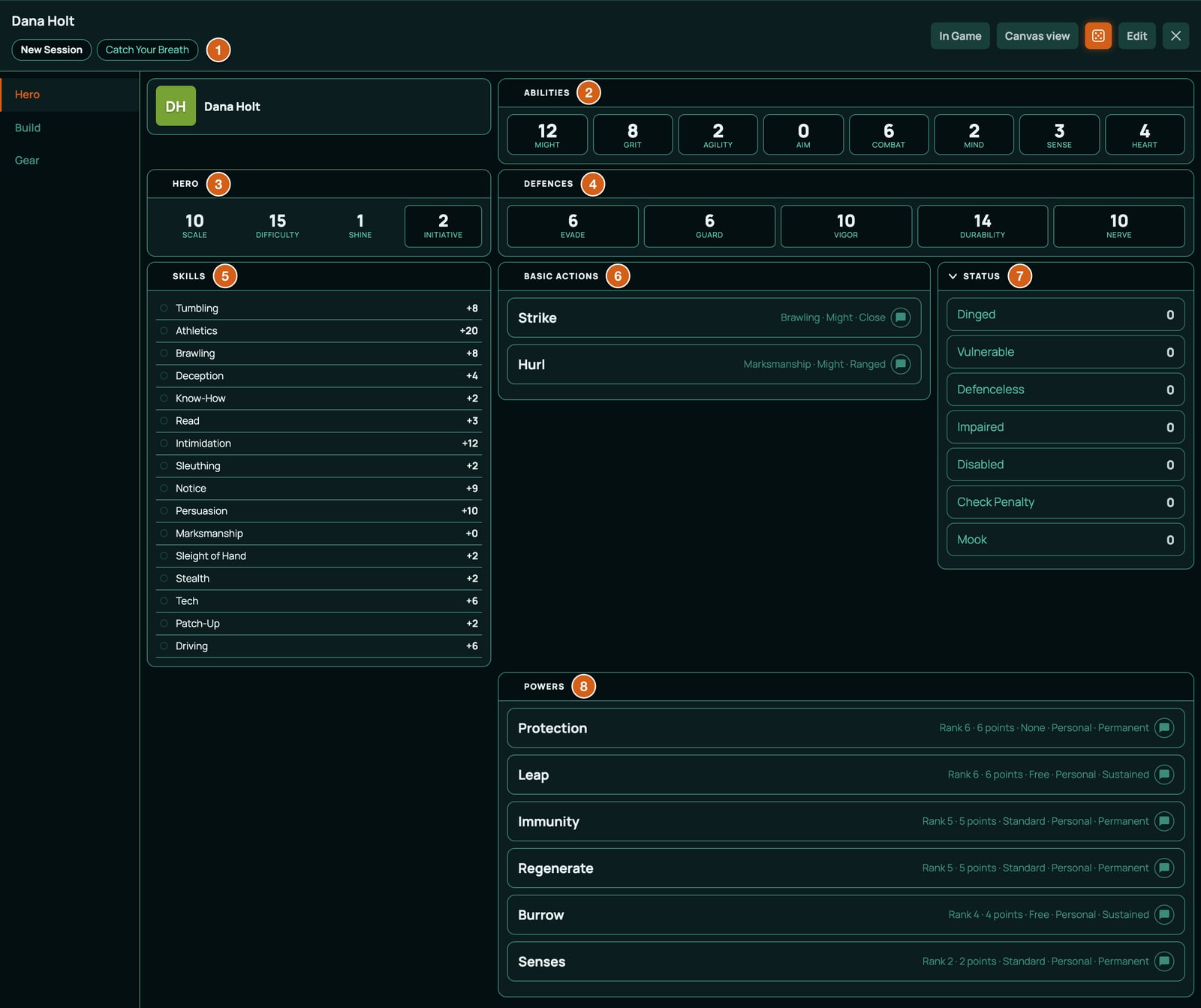
The Hero tab, block by block:
| Block | What's in it | What clicking does |
|---|---|---|
| Portrait | The hero's picture. | |
| Abilities | The eight ability ranks. | Rolls a check with that ability against the Difficulty. |
| Hero | Scale, Difficulty (the number checks are rolled against, 15 to start), Shine and Initiative. | Initiative rolls d20 + Initiative. The others are numbers you change with Edit. |
| Defences | Evade, Guard, Vigor, Durability and Nerve. | Rolls d20 + the defence, a plain total with no Steps, for when the GM asks you to resist by hand. Durability and Nerve take your Dinged off for you; the others don't. |
| Skills | The sixteen skills, each with its ability and its total. | Rolls a check with that skill against the Difficulty. |
| Basic Actions | Strike and Hurl, every hero's attacks. | Open a row for its Target, Attack and Rank buttons. |
| Status | Dinged, Vulnerable, Defenceless, Impaired, Disabled, Check Penalty and Mook. | Nothing: change them with Edit. |
| Powers | Every power, each with its rank and cost, such as Rank 6 · 6 points. | Open a row for what it does, its buttons and Build. |
Right-click (or press and hold) a roll for its options: see The roll options. In play the numbers are read-only: to change Difficulty, Shine, Scale or a Status field, click Edit at the top of the sheet, change it, and click Done. The player can do this as well as the GM, unless the GM has turned on Freeze characters. Edit isn't in in-game mode, the sheet floating over the board: open the sheet from your token's menu with Open Character Sheet, or from Character Sheets. See Edit your sheet.
The eight abilities, and what's built on them:
| Ability | What it's for | Defences and skills built on it |
|---|---|---|
| Might | Raw strength: lifting, shoving, hitting hard. Also the rank of a Strike or a Hurl. | Athletics |
| Grit | Stamina and toughness. | Vigor, Durability |
| Agility | Balance, speed and reflexes. Also your Initiative. | Evade, Tumbling, Sleight of Hand, Stealth, Driving |
| Aim | Hand and eye: throwing, shooting, fine work. | Marksmanship |
| Combat | Fighting up close. | Guard, Brawling |
| Mind | Reasoning, memory and learning. | Know-How, Sleuthing, Tech, Patch-Up |
| Sense | Awareness, intuition and willpower. | Nerve, Read, Notice |
| Heart | Presence and conviction. | Deception, Intimidation, Persuasion |
The five defences:
| Defence | Built from | What it does |
|---|---|---|
| Evade | Agility + bought ranks + what powers and Edges add | Ranged attacks have to reach 10 + Evade. Halved (rounding up) while Vulnerable; 0 while Defenceless. |
| Guard | Combat + bought ranks + what powers and Edges add | Melee attacks have to reach 10 + Guard. Halved while Vulnerable; 0 while Defenceless. |
| Vigor | Grit + bought ranks | Resists poison, disease and anything that works on the body from inside, such as Affliction and Weaken. |
| Durability | Grit + what powers and Edges add (never bought) | Resists kinetic and energy hits: d20 + Durability, less 1 per Dinged, against 15 + the hit's rank. |
| Nerve | Sense + bought ranks | Resists mental hits, fear, control and illusion. Against a mental hit: d20 + Nerve, less 1 per Dinged, against 15 + the hit's rank. |
Every skill is its ability plus the ranks you bought. Athletics, Brawling, Deception, Driving, Intimidation, Know-How, Marksmanship, Notice, Patch-Up, Persuasion, Read, Sleight of Hand, Sleuthing, Stealth, Tech and Tumbling are all a skill check like any other: click one, and it rolls against the Difficulty. Brawling is also the attack roll for Strike and close powers, and Marksmanship for Hurl and ranged ones.
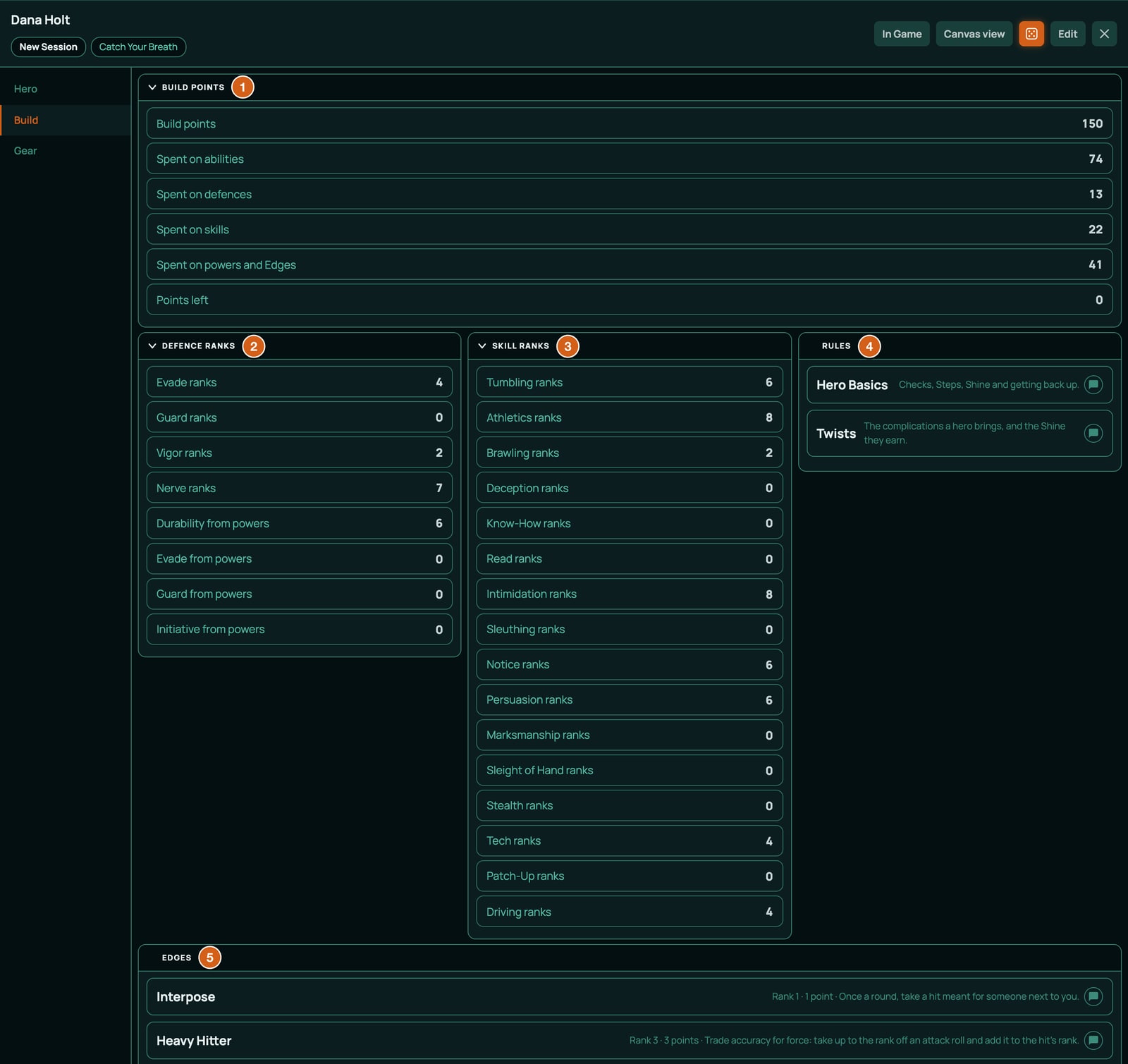
The Build tab is where the budget lives:
| Block | What's in it |
|---|---|
| Build Points | Build points (15 × Scale), Spent on abilities, Spent on defences, Spent on skills, Spent on powers and Edges (filled in for you from every power and Edge as built) and Points left. |
| Defence Ranks | The ranks bought for Evade, Guard, Vigor and Nerve, and what powers and Edges add: Durability from powers, Evade from powers, Guard from powers and Initiative from powers. The "from powers" rows fill in by themselves. |
| Skill Ranks | The ranks bought for each skill. |
| Rules | Hero Basics, the rules in one card, and Twists. |
| Edges | Every Edge, each with its rank, cost and Build. |
To retune a finished hero, click Edit, then Re-run character setup: the builder opens with your choices kept. You can also type new ranks into Defence Ranks and Skill Ranks in Edit mode, but only the builder checks the caps there.
The Gear tab holds Cash, the hero's purse in dollars and cents, Gear for anything they carry, and Resources. Brightline comes with no ready-made gear: what a hero owns is part of the story, and the Equipment Edge covers the useful things.
Rolling
Make a check
A check is any roll where the outcome is in doubt and nobody is attacking: forcing a shutter, spotting a tail, talking a crowd back from the wire.
- As the GM, say which ability or skill it uses and call the Difficulty: 10 is easy, 15 a real effort, 20 hard, 25 heroic, 30 near impossible.
- If the Difficulty isn't the one on the sheet already, click Edit, change Difficulty in the Hero block, and click Done. It stays at that number until you change it again.
- Click the ability or skill. RollQuest rolls a d20, adds the rank, takes off any Check Penalty, and compares the total with the Difficulty.
The dice roll for everyone (over the sheet, if it covers the board), and a line at the bottom of the sheet shows the total against the Difficulty and its band, such as Notice: 17 vs 15, Success (1 Step). The pop-up at the top right shows only the total. In chat the card names the skill, the Difficulty and the band, such as Notice ≥ 15 and Success (1 Step). A band is the named result a roll lands on.
flowchart LR
  D["The GM calls<br/>a Difficulty"] --> S["Set Difficulty<br/>on the sheet"]
  S --> R["Click an ability or skill<br/>d20 + its rank,<br/>less any Check Penalty"]
  R --> C{"Total against<br/>the Difficulty"}
  C -->|"met or beaten"| W["Success<br/>1, 2 or 3 Steps"]
  C -->|"under it"| L["Failure<br/>1, 2, 3 or 4 Steps"]
  L --> SH["Spend Shine to reroll,<br/>or Keep result"]
Steps, and what the GM does with them
Every 5 points over or under the Difficulty is a Step:
| Band | When | Against Difficulty 15 | A rule of thumb for the GM |
|---|---|---|---|
| Success (3 Steps) | 10 or more over | 25 or more | Spectacular. The clip is already trending. |
| Success (2 Steps) | 5 to 9 over | 20 to 24 | Done cleanly, with something extra: faster, quieter, or a clue. |
| Success (1 Step) | Met, or up to 4 over | 15 to 19 | Done. Just. |
| Failure (1 Step) | 1 to 4 under | 11 to 14 | Nearly. Offer success at a cost, or say what went wrong. |
| Failure (2 Steps) | 5 to 9 under | 6 to 10 | It didn't work. |
| Failure (3 Steps) | 10 to 14 under | 1 to 5 | It went badly, and something got worse. |
| Failure (4 Steps) | 15 or more under | 0 or less | As badly as it could. |
Only the total decides a check's band: a natural 20 or 1 on the die doesn't change it. Some rules read Steps themselves: a resistance check turns failed Steps into conditions, and Mind Read reaches deeper with each Step.
Spend Shine to reroll
Shine is a hero's luck and star quality. Every hero starts a session with 1 (more with the Lucky Edge), and earns more when the GM brings in one of their Twists.
After a failed check rolled from the sheet, a strip appears above the result with Spend Shine to reroll and Keep result.
- Spend Shine to reroll rolls the same check again. Any 1 to 10 on the new d20 counts as 10 more, so the new die always counts as 11 to 20; the die itself still shows the face it landed on, and the 10 shows in the roll's breakdown. The result carries the check's name with (Shine), such as Notice (Shine), and 1 comes off Shine by itself.
- Keep result puts the buttons away. So does rolling anything else.
You get one reroll: a rerolled result offers nothing more. With no Shine left the button is greyed out, with No Shine left. It doesn't appear on attack rolls, on a defence rolled from the sheet, or on the card that asks you to resist a hit. To spend Shine on one of those, take 1 off Shine with Edit, roll a fresh d20 (the Roll a d20 macro will do), count 1 to 10 as 11 to 20, and the GM applies the new result.
Shine buys a few other things, each taken off by hand: shaking off Rattled or Reeling at once, adding a detail to the scene (a fire escape just where you need it), or asking the GM for a nudge. The Inspiring and Born Leader Edges spend it too.
What changes a roll
Brightline has no advantage or disadvantage: every check is one d20. These change it instead:
- Impaired and Disabled take 2 or 5 off every check and attack roll, through the sheet's Check Penalty, once you set the Impaired or Disabled field to 1. Disabled replaces Impaired. They don't change resistance checks, defence rolls or Initiative.
- Dinged takes 1 a time off every check to resist a hit.
- Vulnerable and Defenceless change Evade and Guard, and so what attacks on you need, once you set their fields.
- Help from an ally adds 2 (Teamwork makes it 2 plus its rank), and some Edges and conditions name a bonus of their own, such as Sure Aim's 5 and Strike First's 2. Add these with Situational modifier in the roll options, on an attack or a check alike: a +2 adds 2 to the roll, and the Difficulty stays where it is.
The roll options
Right-click a roll on the sheet (press and hold on a phone) for its options. In a Brightline game the window has:
| Option | What it does | Default and limits |
|---|---|---|
| Flat | One d20. It's the only choice: Brightline has no roll modes. | Flat |
| Situational modifier | A bonus or penalty for this roll only, with − and +. Use it on attacks and checks (see above). | +0; from −5 to +10 |
| Public, GM only, Self | Who sees the result. | Public, unless the GM's Default roll audience starts it on GM only |
| Roll | Rolls with these options. |
Other ways to roll
- The Shortcut Bar. Put a power or a basic action on it from Character Actions; clicking it offers Attack or Rank. It rolls as the sheet does, but without a target, so the GM compares the attack. See Shortcut Bar.
- Chat. Type
/roll 1d20+8for a d20 plus 8. See Roll dice. - Macros. A Brightline game is offered two ready-made macros: Roll a d20 (
#d20) and Secret check (#secret), which asks for a bonus and shows the result only to you and the GM. See Ready-made macros. - The dice tray works too. Leave it on Normal: its Adv and Dis aren't part of Brightline.
Only a check rolled by clicking the sheet names its Steps and offers Shine.
Attacks
Every hero has two attacks in Basic Actions: Strike (Brawling against 10 + the target's Guard, close) and Hurl (Marksmanship against 10 + Evade, ranged, throwing whatever is to hand). Both hit with a rank equal to your Might, as kinetic hits. Attack powers, such as Blast, hit with their own rank.
To attack a token on the board:
- Open the attack's row on the sheet and click Target. The target list opens.
- Click the target in the list, or select its token on the board and click Select. Its face shows on the Target button.
- Click Resolve (it names the attack, such as Resolve Strike on 1). RollQuest rolls the attack and checks it against 10 + the target's Guard for a close attack, or 10 + its Evade for a ranged one.
- On a hit, a Roll your damage card at the bottom right asks you to roll the hit: click Roll. The rank is a fixed number, such as Dana Holt's Might 12.
- The target resists (see Resisting a hit). A villain's check is thrown on the GM's screen at once; a hero's player gets a card to roll.
A natural 20 always hits and is a critical hit: the target resists 5 harder. A natural 1 always misses. A miss posts a line such as Ghostlight missed (12 vs 10 + Guard 6). A hit posts what the target rolled to resist, against what, and what landed. Perception and Area powers make no attack roll at all (No roll to hit): their targets go straight to resisting, and an Area power takes up to six. See The target list for every control in the list.
flowchart TD
  A["Target, then Resolve<br/>d20 + Brawling or Marksmanship"] --> H{"Against 10 + Guard (close)<br/>or 10 + Evade (ranged)"}
  H -->|"miss, or a natural 1"| M["Missed: nothing lands"]
  H -->|"hit, or a natural 20"| K["Roll the rank<br/>Might for Strike and Hurl,<br/>the power's rank otherwise"]
  K --> RS["The target resists:<br/>d20 + Durability (Nerve if Mental),<br/>less 1 per Dinged,<br/>against 15 + rank, 5 more on a natural 20"]
  RS -->|"met or beaten"| G["It glances off"]
  RS -->|"failed by 1, 2, 3 or 4+ Steps"| LD["Dinged, then Rattled,<br/>then Reeling, then Down"]
Dana Holt Strikes at Ghostlight: d20 + Brawling 8 against 10 + Guard 6, so a total of 16 or more hits (8 or more on the die). On a hit, Ghostlight resists with d20 + Durability 6 against 15 + her Might 12 = 27. It can't reach 27 with one d20, so every hit lands something: a total of 23 to 26 leaves it Dinged, 18 to 22 Dinged and Rattled, 13 to 17 Dinged and Reeling, and 12 or less puts it Down.
RollQuest doesn't add Sure-Shot, Wild, Sure Aim or Flurry for you: the GM rules on those, or you add a bonus with Situational modifier.
Hits, conditions and recovery
Resisting a hit
Nobody in Brightline has hit points. When a hit lands, the target rolls d20 + Durability, less 1 for every Dinged they already carry, against 15 + the hit's rank (5 more on a critical hit). A Mental hit is resisted with Nerve instead, still less Dinged. Kinetic and Energy hits use Durability.
| Result | What lands |
|---|---|
| Success, by any number of Steps | Nothing: the hit glances off. |
| Failure by 1 Step (1 to 4 short) | Dinged |
| Failure by 2 Steps (5 to 9 short) | Dinged and Rattled |
| Failure by 3 Steps (10 to 14 short) | Dinged and Reeling |
| Failure by 4 Steps or more (15 or more short) | Down |
| A Mook fails by any number of Steps | Down |
RollQuest lands the result by itself: the conditions go on the token, and on a hero the Dinged field on the sheet goes up by one, so the next check is harder. Dinged keeps stacking until the hero recovers. The ladder doesn't read what's there already: a second Rattled stays Rattled, and Reeling sits beside Rattled rather than replacing it, so take Rattled off by hand when Reeling lands. As the GM, you can rule that a Reeling hero who fails by 2 Steps or more goes Down; RollQuest doesn't do that for you.
The card that asks you to resist
When an attack aimed through RollQuest hits your hero, a card appears at the bottom right of your screen, wherever you are. Its heading names the attack, your hero and the check, such as Durability resistance, DC 23.
| Control | What it does |
|---|---|
| Roll | Rolls d20 + your defence, less your Dinged, and sends it. The total shows on the row. |
| Open / Secret | With Secret, the table sees dice it can't read, and only you and the GM see the result. Remembered in this browser. |
A villain's check is thrown on the GM's screen with no press. If a player doesn't answer in about 45 seconds, the check goes to the GM, and if nobody answers then, nothing lands. The card has no Spend Shine to reroll: spend it by hand (see Spend Shine to reroll). With Saving throws on the resolution card set to Only you in Game settings, players read what landed but not the numbers.
When a villain hits a hero (GM)
A villain's attacks are written on its stat block for you to roll; RollQuest resolves the hit once you apply it:
- Roll the attack: for Ghostlight's Bite of Light, "+10 against 10 + Guard", type
/roll 1d20+10in chat, or use Secret check with a bonus of10to keep it hidden. - Compare it with 10 + the hero's Guard (Evade for a ranged attack), from their sheet. Dana Holt's Guard is 6, so a total of 16 or more hits her.
- On a hit, right-click the hero's token and choose Apply Damage. Type the hit's rank as the amount (8 for Bite of Light; add 5 on a natural 20), pick its type (Kinetic, Energy or Mental), and click Apply. A message says the hero resists a rank 8 hit.
- The hero's player gets the card to resist, here Durability resistance, DC 23, and clicks Roll. What lands goes on the token and the sheet by itself.
In Brightline, Apply Damage never subtracts anything: the amount is always the rank of a hit to resist. See Damage and healing.
Dana Holt resists Bite of Light with d20 + Durability 14 against 23: 9 or more on the die and it glances off; 5 to 8 leaves her Dinged; 4 or less, Dinged and Rattled.
Afflictions
Six attack powers don't harm: they numb, net, drain, fool, transform or sap. Each is resisted against 10 + its rank, with its own defence and its own ladder. Dinged doesn't count against an affliction, and an affliction doesn't add a Dinged. Failing by more Steps than the ladder has lands its last rung, and a Mook that fails lands the last rung at once.
| Power | Resisted with | 1 Step | 2 Steps | 3 Steps |
|---|---|---|---|---|
| Affliction | Vigor | Hindered | Immobile | Paralysed |
| Snare | Evade | Hindered and Vulnerable | Immobile and Defenceless | Immobile and Defenceless |
| Drain | Nerve | Impaired | Disabled | Entranced |
| Illusion | Nerve | Dazzled | Entranced | Compelled |
| Transform | Vigor | Impaired | Disabled | Paralysed, turned to glass, wood or salt |
| Weaken | Vigor | Impaired | Disabled | Down |
Conditions
Conditions go on the token. Four of them also change numbers on the sheet, and the board doesn't change the sheet for you: while the token has one, set its field in the sheet's Status block to 1 with Edit, and back to 0 when it ends (or let New Session clear it).
| Condition | What it does | On the sheet |
|---|---|---|
| Dinged | Each one takes 1 off your next checks to resist a hit. They stack. | Dinged counts them; RollQuest adds one when you fail to resist |
| Rattled | One action a turn: a move or something else, not both. | |
| Reeling | Rattled and Hindered at once: one action a turn, at half speed. | |
| Down | Out of the fight. No actions, and Defenceless, until someone gets you up or the scene ends. | Set Defenceless |
| Hindered | You move at half speed. | |
| Immobile | You can't move, though you can still act where you stand. | |
| Vulnerable | Evade and Guard are halved, rounding up. | Set Vulnerable |
| Defenceless | Evade and Guard count as 0. | Set Defenceless |
| Impaired | 2 off every check and attack. | Set Impaired |
| Disabled | 5 off every check and attack, in place of Impaired. | Set Disabled |
| Dazzled | Anything beyond arm's reach is hidden from you. | |
| Entranced | You take no actions. Any harm, or a shake from an ally, breaks it. | |
| Compelled | A will not your own picks one action for you each turn. | |
| Controlled | Someone else chooses everything you do on your turn. | |
| Prone | Melee attacks against you gain 5, ranged ones lose 5, and you're Hindered until you spend a move getting up. | |
| Grabbed | Hindered and Vulnerable; break free with Athletics or Tumbling against the hold. | Set Vulnerable |
| Paralysed | You can't move or act, though you can think. Defenceless. | Set Defenceless |
Add and remove conditions on a token as for any game: see Conditions.
Rest: New Session and Catch Your Breath
Brightline has two rest buttons, under the hero's name on the sheet:
| Button | When | What it does |
|---|---|---|
| New Session | At the start of each session. | Sets Shine back to 1, clears Dinged, Vulnerable, Defenceless, Impaired and Disabled on the sheet, and takes every condition off the hero's token. |
| Catch Your Breath | A minute out of the fight. | Takes 1 off Dinged. When that takes the last one, the Dinged condition comes off the token too. |
Click one: a preview shows what will change, such as Dinged decreased 2 → 1, and nothing happens until you click the rest's name to confirm. The chat card says what the rest did, such as Hero Basics: Dinged decreased and Conditions: Dinged removed. Hover over a button for a one-line summary, such as A minute out of the fight. One Dinged fades. Everyone rests on their own sheet. See The rest preview, part by part.
New Session clears the token as well as the sheet. Catch Your Breath lifts only Dinged, with the last one: take Rattled, Reeling or Down off the token yourself when the story says, such as when a hero spends Shine to shake one off. With the Lucky Edge, add its ranks to Shine by hand after New Session.
Other ways back, by the rules: Second Wind clears one Dinged once a scene; Healing clears one per rank, ends Rattled or Reeling, and at rank 5 gets someone up from Down; Regenerate clears them over time; and spending a Shine ends Rattled or Reeling. Down lasts until someone gets you up or the scene ends. Nobody in Brightline dies by accident: Down is out of the fight, not dead.
Villains and Mooks (GM)
Brightline comes with fifteen villains and five kinds of Mook, the nameless henchmen who go Down the first time they fail to resist. To add one, open the menu, click Enemies, then + Add, choose From the library and search for it, such as Ghostlight. They have no challenge rating, so there's no CR range. See Enemies and the creature library.
| Name | Kind | Faction | Evade | Guard | Durability | Vigor | Nerve | Initiative | Cannot be |
|---|---|---|---|---|---|---|---|---|---|
| Halcyon | Villain, Scale 13 | Second Dawn | 10 | 8 | 12 | 9 | 13 | 6 | Dazzled |
| Grievance | Villain, Scale 10 | The Null Society | 8 | 9 | 11 | 10 | 10 | 4 | |
| The Static Saint | Villain, Scale 12 | Afterimage | 11 | 7 | 10 | 12 | 12 | 8 | Grabbed, Immobile |
| Breakwater | Villain, Scale 11 | Halberd Dynamics, gone rogue | 6 | 10 | 12 | 12 | 6 | 2 | |
| Mirrorball | Villain, Scale 9 | Formerly Vivid | 10 | 6 | 7 | 6 | 11 | 7 | |
| Tidebreaker | Villain, Scale 10 | Bayside Yards | 8 | 9 | 11 | 10 | 9 | 5 | |
| Cinderjack | Villain, Scale 9 | Lowmarket | 9 | 8 | 8 | 8 | 7 | 6 | Dazzled |
| Ghostlight | Villain, Scale 8 | Afterimage | 10 | 6 | 6 | 8 | 8 | 10 | Grabbed |
| The Choir | Villain, Scale 12 | Afterimage | 7 | 7 | 12 | 12 | 12 | 3 | Entranced, Compelled, Controlled |
| Deputy Director Rhee | Villain, Scale 8 | The Accord Bureau | 6 | 6 | 6 | 6 | 10 | 4 | |
| Gravelmouth | Villain, Scale 10 | Bayside Yards | 4 | 8 | 12 | 13 | 5 | 1 | |
| Hightail Jane | Villain, Scale 9 | Off-Line | 12 | 9 | 6 | 6 | 8 | 14 | |
| Wraithwire | Villain, Scale 9 | Off-Line | 9 | 5 | 7 | 6 | 10 | 9 | |
| Lantern | Villain, Scale 11 | Second Dawn | 10 | 8 | 9 | 9 | 12 | 7 | |
| The Hollow King | Villain, Scale 14 | Afterimage | 9 | 10 | 16 | 14 | 14 | 6 | Entranced, Compelled, Controlled, Dazzled |
| Halberd Security Drone | Mook, Scale 6 | Halberd Dynamics | 7 | 3 | 4 | 4 | 0 | 6 | Entranced, Compelled, Dazzled |
| Second Dawn Acolyte | Mook, Scale 5 | Second Dawn | 5 | 5 | 3 | 4 | 6 | 3 | |
| Null Society Enforcer | Mook, Scale 6 | The Null Society | 5 | 6 | 5 | 5 | 6 | 3 | |
| Bayside Yards Heavy | Mook, Scale 5 | Bayside Yards | 4 | 6 | 4 | 6 | 3 | 2 | |
| Scorch Flicker | Mook, Scale 5 | Afterimage | 7 | 4 | 3 | 5 | 5 | 8 | Grabbed |
Villains from Checkpoint North-7 and from the creature library arrive linked to their stat blocks, so there's nothing to link by hand. Right-click a villain's token and choose Stat block to read it: its defences (Evade, Guard, Durability, Vigor, Nerve), its Dinged and Mook marks, its conditions, what it Cannot be, its notes, and its actions, such as Ghostlight's Bite of Light (close attack, +10 against 10 + Guard, a hit of rank 8, energy) and Pounce (moves and attacks as one action, knocking the target Prone on a hit). A Mook's token carries the Mook badge.
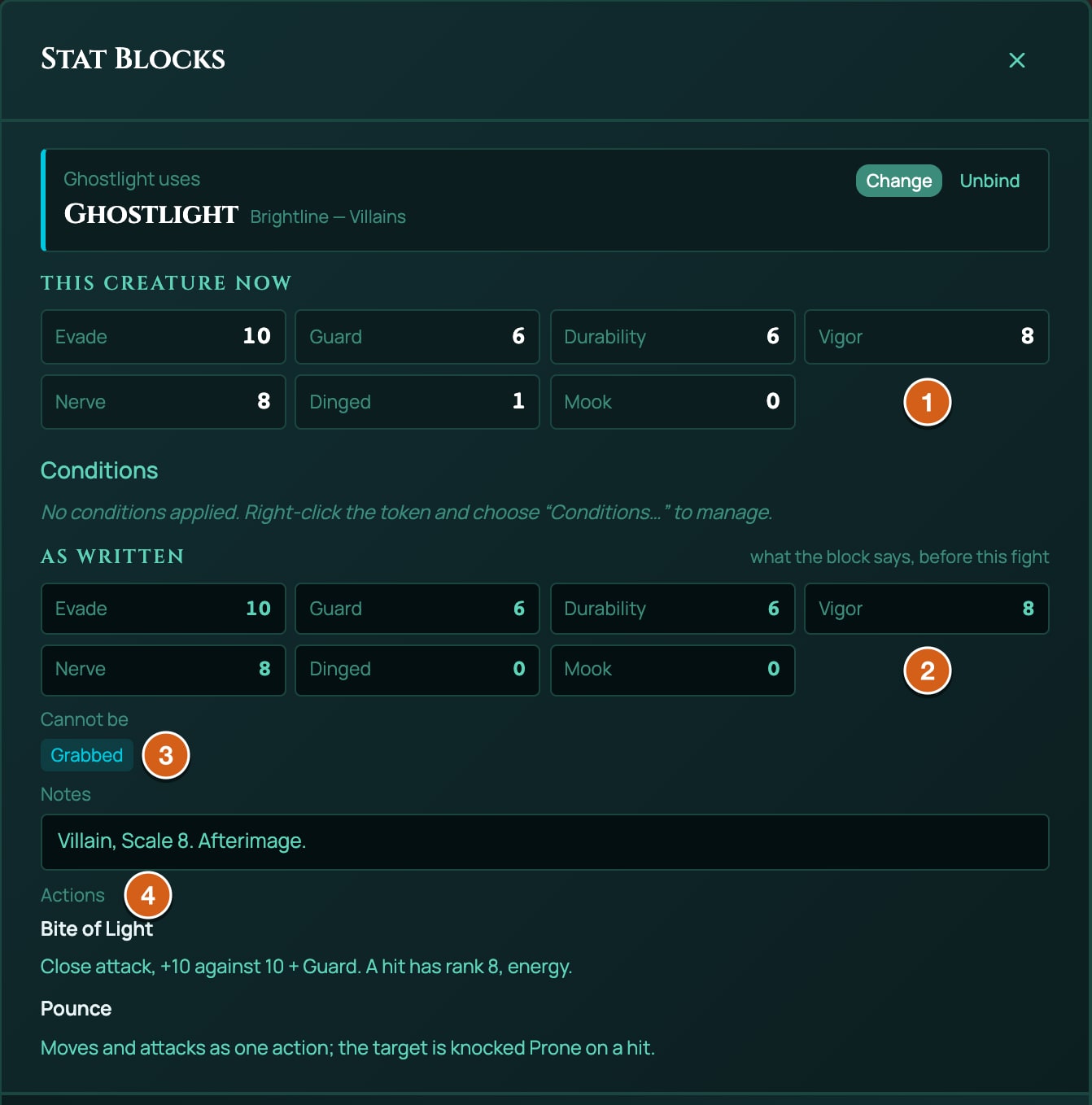
Heroes' attacks on villains resolve fully, with the villain's check thrown on your screen. A villain's own attacks are printed text: roll them yourself and apply the hit as in When a villain hits a hero. Their other actions, such as Halcyon's Burn Bright or Wraithwire's Lockdown, are yours to describe and rule on.
In a battle, initiative is a d20 plus Initiative: a hero rolls with Roll Initiative or by clicking Initiative on the sheet while the tracker shows Rolling. A villain's Initiative is in the table above; the stat block doesn't show it. See Start a battle. A grid square is 5 feet, and a round is 6 seconds.
Good to know
- Brightline is on every plan. So are Checkpoint North-7 and adding powers and Edges with + From pack (see Add a power or an Edge). The sheet's Items panel is on Pro.
- Set the Difficulty before you roll. A check's band is read against whatever Difficulty the sheet shows, and it stays where you left it. Set it back to 15 afterwards if your table likes a default.
- Twists and Shine are counted by hand, except the Shine a reroll spends.
- Mark the four status fields. Vulnerable, Defenceless, Impaired and Disabled only change the sheet's numbers once their field is 1.
- The GM checks one cap: a power's attack bonus plus its rank can be at most twice Scale.
- Brightline has its own content for homebrew: new powers, Edges and gear. See What you can build and The pack file.
- Rest buttons for homebrew: an effect that should happen at New Session uses the trigger
longRest, and at Catch Your BreathshortRest. See Effects.
Related
Game systems · Create a character · Your sheet at the table · Conditions · Enemies and the creature library · Glossary